23 September 2026

1884 Virginia Lynching

(My great grandpa is seated in the chair with two of his brothers beside him.)

I received the following email in answer to some questions of a 1884 lynching around Monterey, Virginia, in which my Great Grandfather John Robert Warwick may have been a part of the 1884 lynching mob in Monterey, Virginia of 1884. There was an older John Robert Warwick, which was an uncle to my great grandpa J.R. Warwick. (The email was dated 29 April 2011, from Michael Sellers)

This is an update of the 1884  lynching as it was sent to me.
"Hi, Linda, Just came across your message from March 20 seeking information about you great grandfather, John Robert Warwick, and the January 1884 lynching of E. D. Atcheson in Monterey, Highland County, VA.  I've done quite a bit of research regarding the lynch-murder of Atcheson.  I am a distant cousin of three of the men involved.  My research was more involved in what happened to and became of the men after they fled Highland County.  Another elder cousin of mine is a direct descendant of one of the men, while being related as a cousin to two others.  His research was extensive, which he then developed into a book.

"I regret to report that your great grandfather, John Robert Warwick, was not the lone man tried and acquitted by a Rockbridge County jury.  In fact, evidence and firsthand testimony shows that your great grandfather was not only an active participant but also nearly committed another murder during the lynch mob's removal of E. D. Atcheson from his jail cell.

"First, the lone man tried and acquitted of the charges by jury was John Anderson"J. A." Chestnut.  J. A. Chestnut was the only one of the 10 involved in Atcheson's murder to not flee Virginia.  Chestnut had been married for 11 years to Nancy Wiley and had 6 young children at the time of Atcheson's lynch-murder, plus his wife was 8 months pregnant with their 7th child.  I suspect that having 6 young children with the imminent arrival of a 7th were large reasons why he didn't flee.  Chestnut was born in Highland County and was well-known.  The trial was moved from Highland County to Rockbridge County in order for Chestnut's lawyer(s) to convene an impartial jury and to receive a fair trial.  

"I don't have the particulars of the trial itself, however, Chestnut was indeed acquitted of all charges.  After the trial, Chestnut returned to Highland County where he and his wife, Nancy, had at least two more children prior to 1890.  Chestnut and his wife separated shortly after 1910 and were divorced by 1920.  Upon the separation, Chestnut removed to the town of Cass in neighboring Pocahontas County, WV.  Chestnut died there on July 1, 1926, at the age of 77.  His body was returned to Mill Gap in Highland County where he was buried in Bird Cemetery.

"Second, in regards to your great grandfather, John Robert Warwick, he was positively identified by the jailer, Joseph Hiner, as being one of the 10 men who removed Atcheson from the jail and lynched him.  The following is somewhat of a paraphrase of Joseph Hiner's testimony when arrest warrants were issued for 9 of the 10 men involved in Atcheson's lynch-murder.  The 10th man has escaped anonymously into history as Hiner was unable to identify him:

"Just after midnight, in the early morning hours of Friday, January 4, 1884, 10 men broke into the Monterey jail, took E. D. Atcheson from his cell and lynched him from a tree on Trimble's Knob near Monterey. The jailer, Joseph Hiner, gave sworn testimony that 10 men, all smelling of liquor, approached and demanded the keys to the jail in order for Atcheson to be taken. Hiner refused, stating that he didn't have the keys, and the men abruptly left. A short time later the men again approached the jail but, this time, they were in possession of all the guns and weapons they could carry along with a rather large log that was to be used as a battering ram against the doors of the jail and Atcheson's cell itself. Hiner, however, stood in their way and, after a heated exchange in which one of the men, Robert Warwick, attempted to fire a rifle at Hiner himself, the men contented themselves with firing their weapons into the jail. Hiner further testified that many of the men were able to fire at Atcheson from close range, so close that Atcheson was able to knock the gun or rifle out of the hands of at least two of the men. Finally, the men were able to bust through the doors of the jail and into Atcheson's cell. Hiner stated that Atcheson was shot multiple times, at least four times from what he could see, and was barely breathing and nearly unconscious when the men dragged him out of the jail and into the snow. 

"Once outside, the men bound his ankles and wrists and began dragging him through the snow towards Trimble's Knob. Hiner further stated that one of the men shouted at him that he [Hiner] could find Atcheson at a particular tree along the road in the morning. At daylight the following morning, Hiner followed the trail of blood in the snow left by Atcheson being shot and dragged and indeed found him hanging from a white oak tree on Trimble's Knob located on Spruce Street just south of Monterey.

"Based on Hiner's eyewitness testimony, murder warrants were sworn out against 9 of the 10 men. In swearing out the warrants, Hiner stated that he was able to positively identify 9 of the 10 men because the masks worn by each of them had fallen during the course of the night. By the time the men had finally broken into the jail and retrieved Atcheson, they were no longer trying to hide their faces. All of the men identified were from, by all accounts, "outstanding families in the area", and most all of them were related in some way whether as cousins or by marriage.

"The family of one of the men involved, Giles H. Gum, independently corroborated Hiner's testimony by stating that Robert Warwick had indeed leveled a rifle at the jailer, Joseph Hiner, at close range with his finger on the trigger and was about to fire when Gum knocked the rifle from his hands at the last moment.  

"There is some speculation that Warwick did indeed fire his rifle at Hiner but that Gum knocked the rifle away a split second prior and the bullet instead richocheted off the jailhouse rather than striking Hiner.

"Though positively identified by the jailer, Joseph Hiner, the reason and/or cause of Robert Warwick's involvement in Atcheson's lynch-murder is the hardest to figure.  Most of the other men involved lived in the area around Mill Gap in Highland County and were related as cousins or by marriage, however, Warwick doesn't seem to be related to any of them and was, according to the previous 1880 Census, living in Huntersville in Pocahontas County, WV, some 25 miles southwest of Mill Gap.  Robert Warwick was definitely there and was well-known to the jailer, Joseph Hiner,  But, why or how Robert Warwick came to be in the Mill Gap area and how or why he came to be involved in Atcheson's lynch-murder is still murky, at best.

"According to John Robert Warwick's obituary in the "Fairview Newspaper" of Woods County, OK, he was married to Signora Gwin on January 16, 1882, in Harper's Ferry, WV.  He later "came to Kansas and taught school at Coldwater, waiting for the opening of Oklahoma's Cherokee Strip for settlement.  He 'made the run' Sept. 16, 1893.  As he was accustomed to the water and wood in abundance on the wooded hills and plains of West Virginia, he looked first for wood and water when looking for a homestead. He staked a claim 7 miles south of Alva, on Eagle Chief, but learning by experience that more abundance lay in the level wheat lands--he sold his wood-and-water farm and bought level wheat land 5 miles south of Alva. Here he and his wife lived until 1929 when they moved to Alva. His wife preceded him in death three years, almost to the exact time of his death, dying in Nov., 1934. John R. was said to have had cancer of his jaw."

"According to what I have, his 2nd child, Robert Lee Warwick, was born in November 1887 in West Virginia.  John Robert Warwick likely made the move to Kansas in either 1888 or 1889 before then "making the run" into Oklahoma in 1893.  Third child, Wilbur, was then born in Alva, Woods County, OK, on Oct. 13, 1895.

"I'm sure that Robert, as most did, came out to OK in 1893 and likely staked out where he was going to "make his run" in preparation for the Sept. 16, 1893, run into OK for the land grab.  I don't know, however, exactly when he left WV for KS prior to making the run into OK.

"Hope the above helps answer some of your questions.  I'm curious if there have been any stories handed down regarding his involvement in Atcheson's murder, even if its just rumor.  I've spoken to a good many descendants of the men involved, and invariably they report stories of the families uprooting in the middle of a night, piling into wagons all they could carry and simply disappearing into the night fleeing from Virginia.  Warwick appears to have just simply returned to neighboring Pocahontas County, WV, before then heading on to KS some years later.  I'd be interested in any info you have that could fill in some of the blanks.

11 August 2026

Vada Paris' Dust Bowl OkieLegacy

This is a photo of my mother, Vada Eileen (Paris) McGill in the 1930s. Ylova Jean Jaquith Mayes daughter and son-in-law sent the  following message with the photo attached to this NW Okie in 2010.  The photo was not dated, but Ylova was born in 1932. She looks like she is maybe 4-5 in the photo. So, the 1937-1938 time frame would be about right. 

The photo shows a young Vada Paris (left) in her flowery, Spring dress, hat and white sandal heels holding the hand of a young girl (Ylova Jean Jaquith) while standing in front of a passenger train in Woodward, Oklahoma. The Jaquith had brought Vada to Woodward from Seiling to catch the train to Alva, Oklahoma, where Vada was attending NSTC (Northwestern State Teachers College). We know that Vada was a sophomore at NSTC in Alva. We believe she attended in 1937 as a freshman.

Let us take you back to April 18, 1932 (as written down in Vada's 1938 diary as an anniversary) when a sixteen year-old-girl named Vada Eileen Paris came to live with the Ray and Eithel Jaquith family who lived in Seiling, Oklahoma. Also, it was during the Depression, Dust Bowl era. Besides the anniversary of when Vada went to live with Jaquith's in Seiling, Vada had made a notation in her diary May 25th for Ray and Eithel Jaquith anniversary, May 25, 1926.

While living with the Jaquith family, Vada graduated from Seiling High School with the Class of 1936 Seniors whose motto was "Hitch Your Wagon to a Star." For reasons unknown to this writer, Vada laid out a year or so before graduating high school during the Depression, Dust Bowl days. She should have graduated in 1934, but graduated in 1936, instead.

We know that Black Sunday was April 14, 1935 when the day was turned into night during the Dust Bowl era. About a month and a few weeks before that day, Northwest State Normal school's Castle on the Hill had burned down, March 1, 1935, in Alva, Oklahoma.

I have been told Aunt Geneva's story is her parents, Ernest Claude & Mary Barbara (Hurt) Paris, lived in a Sharecropper’s home. it  burned to the ground during the 1930s dust bowl days.  The girls were sent to different homes. Auntie Jim (aka Zella) was already married. Geneva had been going to school at Seiling but had to move in with Uncle Alvin in Alva, and Jaquith’s gave  Vada a home. We were told that most of the boys joined the service.

We have pieced together bits and pieces of Vada's life between 1932 thru 1937 before she attended college in Alva. We have been told that Vada's mother did not think Vada needed education after the eighth grade and should stay home and help take care of her younger siblings. We have also been told that Eithel Jaquith influenced Vada to graduate Seiling High School and continue her education at NSTC in Alva, Oklahoma.

Reading through Vada's diary, we know in 1938 she received a government grant to attend Northwestern State Teacher College (NSTC) where she was noted as a sophomore in the 1938 Ranger Yearbook. Vada also worked at Warrick's Shoe Store; did heavy housekeeping to make ends meet while attending NSTC. We believe Vada was a Freshman at NSTC (1937 Ranger Yearbook) in 1937.

Vada's older brother (Alvin Riley Paris) and his wife, Naomi (Warren) Paris, were living in Alva while Vada was attending Northwestern. Besides staying with her older brother, Vada did housekeeping for Naomi and Alvin while Naomi was expecting their first Child (Stan born February 25, 1938).

There were lots of entries in Vada's 1938 diary where she mentioned the enthusiasm of getting to go home to Seiling and seeing the Jaquith family (Ray & Eithel and their children: Kenneth and Ylova).

On one entry dated February 13, 1938, Sunday, Vada writes, "Saw Mrs. Jaquith. I'll tough it out where I am before borrowing money. Grand of her to offer to help." Times in the 1930s were tough on everyone back then.

Vada wrote about enjoying receiving letters from Eithel Jaquith. The Jaquith family was like a second family for this young woman, Vada Eileen Paris. Eithel being the one that encouraged Vada to continue her education and go to College at Alva, Oklahoma. 

David M Wagner's Journey (10 October , 1943-10 May 2025)

The extraordinary legacy of David Matthew Wagner began 81 years, 7 months ago, in Orange, New Jersey, on October 10, 1943, as the third child of Anita Gretchen Williams (35) and Louis Alwin Wagner (David Matthew Wagner's earthly journey came to a close on Saturday, May 10, 2025, at 01:01 pm, at St. Anthony Pavilion Center in Oklahoma City, Oklahoma. His body was cremated and a memorial celebration of life will be scheduled for a Wagner family reunion at a later date. He was blessed with an older sister, Joan Elizabeth (Wagner) Hodgden (1928-1986), and brother, Louis Charles Wagner (1930). David met the love of his life, Linda K. Mcgill, in the Spring of 1968 at NSC (NWOSU) in Alva, Oklahoma. Their hearts intertwined, and they married in the Summer of 1969. Their family flourished with the birth of Michael in the Fall of 1970 and Robert in the Spring of 1973. David's spirit now soars with the eagles, watching over his beloved wife, Linda, two sons, Michael and Robert, numerous Wagner and Hodgden nieces, nephews, and his older brother Lou (Louis) Charles Wagner and Lou's wife Kay and family. David was my guiding light. I didn't realize how much I drew inspiration from him. We shared 56 glorious years of marriage. David embodied the selfless spirit of family care, a shining example to us all. In 1962, David triumphantly graduated from high school in Merced, California with honors, a math award and scholarship that catapulted him to university in San Jose for a year. Afterwards he moved to Alva, Oklahoma, enrolled at NWOSU; joined Alva's National Guard; and worked for his brother-in-law pumping wells. David graduated from NWOSU with a BS degree in chemistry and mathematics, laying the foundation for a lifetime of achievements. David was a great man of many talents throughout his life. He was employed for a time by Kerr-McGee Research & Engineering in Edmond, Oklahoma, where he made a lasting impact. David and his young family moved to his next employment with Exxon Research & Engineering in Baytown, Texas, in Exxon's coal liquidation department, a bold new chapter. David did a stint preparing tax returns in Alva, Oklahoma, helping countless individuals. When American Online (AOL) moved to OKC, Oklahoma, David worked as a tech, guiding AOL members through tech issues with patience and kindness. In the early 2000s David & Linda moved to SW Colorado, working for another tech call service, spreading hope and help. Before he retired in the Colorado rocky mountains north of Durango, at Vallecito Lake, David left an indelible mark. It was in 2022 that David and Linda moved back to NW Oklahoma, Alva, a triumphant return. We will deeply miss this extraordinary husband, father, brother, uncle, a beacon of hope in our lives. Plant a tree in his memory.

29 January 2025

Wds County High School

Woods County High School,  Helena, Okla.


The Woods County High School was established at Helena Nov. 8, 1904 by territorial election held in Woods County, Oklahoma Territory on that date.  (M) Woods County, Oklahoma Territory then consisted of what is now Major, Woods and Alfalfa Counties. 

The actual work on the building began Mar. 1, 1905. The total cost of the buildings was $40,000.00 and it was completed and accepted in April 1906. This building was located where the administration building of the Boys Training school is now located in the west part of town. It had 27 rooms with an auditorium that seated over 800 people.

The school opened Sept. 18, 1905 and was held in the various churches of Helena until the building was completed. There were seven members on the faculty. Charles Eckes was the first graduate in 1906. There were 104 enrolled the first year. The board of trustees consisted of seven members who were from the various towns in the county and were appointed by the Board of County Commissioners. The school was operated as Woods County High School until the county was divided at Statehood in 1907 as it is now. Major County took the bridges on the Cimarron River, Woods County took the court house at Alva and Alfalfa County took the high school at Helena. The school was operated one year 1908-09 as the Alfalfa County High School.

The Connell State School of Agriculture was located at Helena in 1910 and the State of Oklahoma took over the building and grounds. They added a dormitory, shop building, dairy barn, horse barn and a number of other buildings. This was one of the secondary agriculture schools which served NW Oklahoma and grew to where there were over 200 students. In 1917 Gov. Williams vetoed the appropriation for the Connell State School of Agriculture and converted this to the West Oklahoma Orphans Home. However, the State of Oklahoma could not use the school building or grounds on which it was located for an orphans home because the former deed contained a clause which provided that it had to be used for school purposes or it reverted back to the three original owners who gave the grounds for the original old Woods County High School. The State of Oklahoma, then gave the building and grounds on which it was located to the Town of Helena to be used as their school building. The State used the old dormitory to house the orphans as it was located off the school grounds. Helena used the school building to house their grade and high school students from 1918 to 1923. The orphans had grown to over 150 and they did not have room for them in the old dormitory and they had to have more room.

The State of Oklahoma agreed then to pay the Town of Helena $50,000.00 for the building and grounds provided they could give them a good title. The $50,000.00 would build a new school building for Helena on a site which they had in the north part of town. Helena then got busy and located the three men who gave the original deed to the Woods County High School with the reverting clause in it (back to them when it was not used for school purposes). These men agreed to give a deed conveying all of their interest for a consideration of $10,000. Helena then got busy and voted $10,000 bonds and paid them and secured a deed from them conveying a clear title. Helena then built a new building and moved their school to the north part of town.

The orphans home moved from the old wooden dormitory to the brick building which was built as the Woods County High School. When the orphans moved into the new brick building there was nearly 200 of them. All of these ate, slept and went to school in this one building for the first year until they could build dormitories. The boys slept on the upper floor, the girls on the second floor, the first floor was used for school and administrative purposes and the basement was used for the kitchen, dining room and laundry.

There was a real houseful of them. As other dormitories, a dining hall, and a school building were added the orphans home grew to over 300. The old Woods Co. High School building was torn down in 1938 and replaced by a smaller building used as the administration building. The orphans home remained at Helena until around 1941 or 1942 when it was moved to Pryor, Oklahoma.

The State Training School for Boys was then located at Helena and took over the building and grounds. It has remained at Helena since that time except a few years when it moved to Stringtown and then was moved back to Helena.

information from 'Our Alfalfa County Heritage,' pg. 493-494. 

Woods County High School

Alfalfa County High School, also known as Woods County High School, is situated in Helena, Oklahoma. Following the division of M County, Alfalfa County acquired this building, whereas Woods County obtained the Courthouse and Major County received the bridge over the Cimarron. 

Upon Oklahoma's statehood in 1907, 'M' County was divided, and each resulting county selected its name and determined its school district numbers. Major County retained the original district numbers, while Alfalfa County renumbered its schools, commencing in the northeast corner with number one and concluding with 103. Woods County's school numbering system is a combination of retained and modified numbers, as most schools inherited from 'N' County required renumbering. Only the 'M' schools maintained their original numbers.

Additional information on Major County schools can be found in Gloss Mountain County, a history of Major County; Woods County schools in Pioneer Footprints across Woods County; and Alfalfa County schools in Alfalfa County Heritage.

29 December 2024

Northwestern State Normal (NSN)


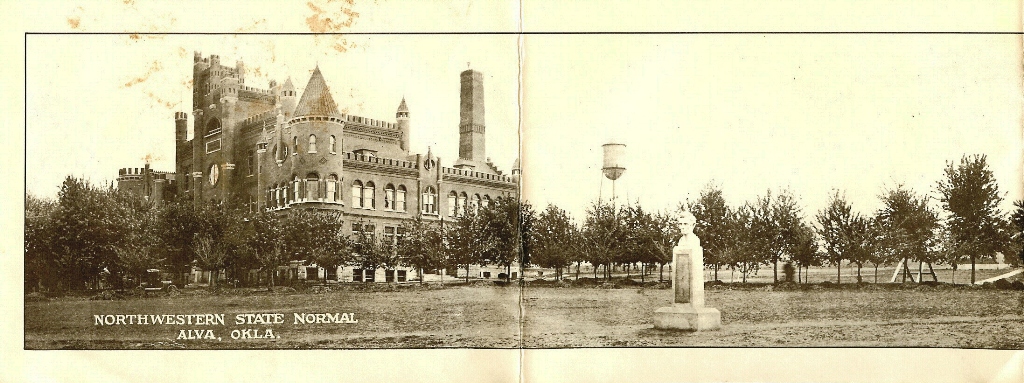
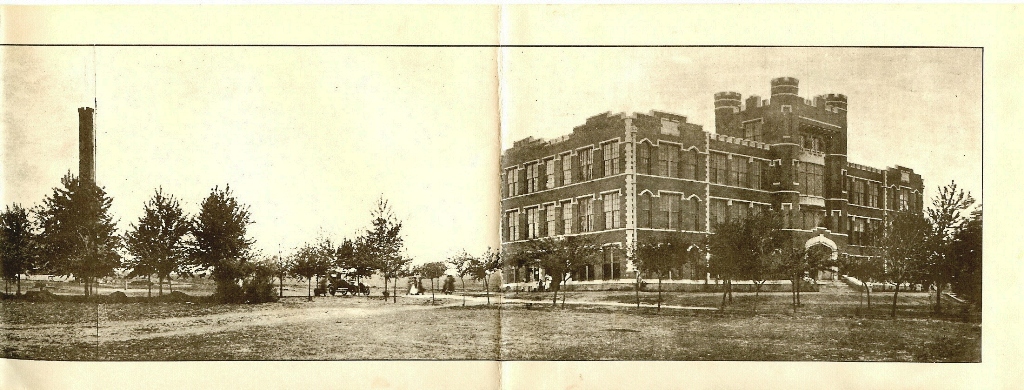
Castle On The Hill (burned to a shell of itself March, 1935). This is an old photo of Northwestern State Normal School, in Alva, Oklahoma, a friend, Lovina Clark (dec'd), gave it to me awhile back (20+ years ago). It is a long panorama photo that I scanned as two photos because at the time my scanner was a small screen machine.


If you look closely you shall notice the Lincoln statue, water tower, chimney in the open area between the two buildings.  This is the area where Herod Hall was eventually built. As you might notice this was taken before Herold Hall (administration building) was built between these two NSN buildings (Castle & Old Science Hall). Sometime later date the Science hall lwas moved to the eastside of the campus into Carter Hall. The old science hall has become many offices throughout its history, such as the music department when I went to NSC in the 1970s. Today it is goes by "Ryerson hall."< as it looks down 7th Street.


  A Silent message thru the ages 

  Is delivered to the races passing by,

  And the wisdom of the sages

  Flashes futily from the sturdy eye,

  Watching Life's laughter, song and tears 

  Thru the eager march of onward years; 

  With quiet, unperturbed, mobile face

  Inspires us to live with equal grace.

  [taken from The Ranger 1926 yearbook] 

06 November 2020

Good Morning, America, Nov 6, 2020!

     Good Morning, America, Nov 6, 2020! My eyes are watery with tears of hope, joy, and an optimistic feeling. I've decided awhile back this elderly woman would never fall for the fear tactics of Trump's political party. 

     I refuse to be a pessimist. I am a moderate Democrat. I have believed in Biden since he announced his decision to run for president. 

     I have so much praise for Georgia's on ground organizers, John Lewis, Stacey Abraham and all the poll workers across America working tirelessly to show us all that America's Democratic process works.

    We just need to be patience, calm as it counts and processes the ballots. 

     My eyes are filled with hope, patience, calm and  optimistic feelings of #BuildingBackBetter our America Democracy.

     My wish and hope is that my sister Dorthy McGill's (1943-2018) soul is seeing the justice unfolding for Trump's downfall and removal.

     Let us all come together over time to Make America Care Again and Unify the country and our allies around the world.

07 July 2020

Break the Cycle Or Be Condemn To Repeat It

I know what is like to live in a dysfunctional family. If you do not break the cycle of dysfunction, you will be condemn to repeat it. I decided a long time ago that the way my older and younger sisters treated each other to get what they wanted was not my cup of tea. I broke from that cycle during the probate from hell. My older sister believed in "all for one. None for all others." My youngest sister always played the victim to get love and attention. My sister Dorthy believed in speaking out, standing up for the injustices. My sister Dorthy was more like a parent-figure to me than my own parents. Thank you Dorthy (1943-2018) for being there for me.

22 June 2019

Benjamin Franklin Connection

Back in May, 2011, I ran across a ancestry connection to the infamous Benjamin Franklin ( Not a direct relationship). The Benjamin Franklin connection appears on my father's side of the family with  the Craighead, Holmes (Homes) and McGill

Let me see if I can get this ancestral connection straight. As I said in an earlier newsletter in 2011, "I found a link to Benjamin Franklin." It turns out that Benjamin Franklin was a brother-n-law of the 1st cousin 3x removed of husband of our 2nd Great Grand Aunt, Nancy McGill, daughter of Wm Nathan McGill, Jr.

Are you totally confused yet? Let me see if I can confuse you more and fill in some more names.

Benjamin Franklin (1706-1790) had an older sister, Mary Franklin (1694-1731), who married Robert Holmes (Homes), the second husband of Mary Franklin

Robert Homes was the son of Katherine Craighead, who was the daughter of Rev. Robert Craighead, who was the son of Rev. Thomas Craighead, who had a son, Rev. Alexander Holmes Craighead, who had a son, Capt. Robert Craighead, who was the paternal grandfather of Samuel Geddes Craighead, husband of my 2nd Great Grand Aunt, Nancy McGill.

Capt. Robert Craighead, who had a son Wm Craighead, who had a son Samuel Geddes Craighead.

Nancy A. McGill's father was Wm Nathan McGill, Jr, who was also the father to David Milton McGill, who had a son, Wm Pearson McGill, who was our Great Grandfather.
 W. P. McGill connects our grandfather, Wm Jacob McGill, who married Constance Estella Warwick. Their sons were Gene and Robert McGill. Gene McGill married Vada Paris and had four daughters, Connie Jean, Dorthy Eileen, Linda Kay and Amber Ann.

NOW! Do I have you totally confused?

This my short version of the Benjamin Franklin connection. Benjamin seems to me to be an in-law of more in-laws and cousins 3 times removed of our 2nd great grand aunt, Nancy A. McGill, and our 2nd great grand uncle, Samuel Geddes Craighead!

So . . . Is Benjamin Franklin related? There is not a direct relationship with the infamous genius known as Benjamin Franklin.

OH! What the heck!  Let's just say some interesting people crossed my McGill ancestors paths.

There were some Craighead's that married into our Warwick ancestors, also! If I can connect the Luttrell ancestors to the McGill's, then there were some Lord's, Sir's and possibly royals in that line!

You can find all sorts of funny family ties if you look long and hard enough, huh?

1730's - The First Great Awakening

A powerful Protestant religious revival swept across the New England colonies and through Georgia starting in the 1730s, later named the First Great Awakening.

Emotionalism, emphasis on individual worship, and skepticism towards religious leadership pumped new life into sects that mirrored these values like Methodism and Baptism. European circuit preachers traveled across the Atlantic, delivering dramatic sermons to crowds larger than populations of colonial cities themselves. Though the revival lasted only a generation, it signaled the end of traditional worship and the rise of evangelical faith.

Mary Franklin (1695–1741) wife of 1st cousin 3x removed of husband of 3rd great-aunt. When Mary Franklin (oldest sister of Benjamin Franklin) was born on September 26, 1695, her father, Josiah, was 38, and her mother, Abiah, was 28. She married Capt. Robert Homes on April 3, 1716, in Boston, Massachusetts. They had four children during their marriage. She died sometime after or around  June 16, 1741, in Dukes, Massachusetts, at the age of 45.<br /><br />
William Homes was father of Capt. Robert Homes (a Rev. and ship Capt.), married to Mary Franklin.oldest sister of Benjamin Franklin and daughter of Josiah Francklin and
Abiah Foulger.

When the First Great Awakening spread throughout New England and Georgia during the mid-1700s, Mary Franklin was living in Massachusetts.
OTHER RELATIVES
4 of our family ancestors lived in In the New England colonies or Georgia during the time when the region was overtaken by a momentous Protestant religious revival:

Capt. Robert Homes (1694–1743), 1st cousin 3x removed of husband of 2nd great grand aunt.

Abiah Foulger/Foulger (1667–1752), 2nd great grand aunt.

Rev. William Homes (1663–1746), husband of 2nd great grand aunt of husband of 2nd great grand aunt.

Katharine Craighead (1672–1754), 2nd great grand aunt of husband of 2nd great grand aunt.

During the religious revival, colonists revived their mission to proselytize to both Native Americans and enslaved African Americans. About 1736, Georgia.

Staunch puritans (called Old Lights) who championed ceremony and traditional church hierarchy rejected the revival’s evangelicalism and its emphasis on a personal relationship with God, while those who accepted it were dubbed New Lights.

THOMAS CRAIGHEAD (1664-1739)

Thomas Craighead (1664-1739) was born and educated in Scotland. He received his degree as a physician from Edinburgh in 1691, and in about 1701, married Margaret Homes (1664-1738), the daughter of a "Scottish Laird", in Scotland. After practicing medicine for a while Thomas then studied divinity and entered trial for the ministry in the Presbytery of Stabane in 1698. He was a Pastor for several years in Donegal, Ireland. Thomas and his family emigrated to Boston, arriving in the first week of Oct., 1714 (some say 1715) on the ship Thomas & Jane (William Wilson, Master), accompanied by his wife and family, including his brother-in-law, Rev. William Homes, who was married to his sister, Katherine Craighead, who was also aboard. Rev. Thomas began preaching in America at Freetown Massachusetts. He moved to New Castle Delaware in the spring of 1723 and joined the Presbytery there. He was installed as the Pastor of the Presbyterian Church at White Clay Creek Delaware on Sep. 22, 1724 and preached for 7 years. He was Moderator of the Synod in 1726. He moved to Lancaster County PA in 1731 and became the Pastor of the Church at Pequea on Oct. 31, 1733. He died on Apr. 26, 1739 in his pulpit at the Big Spring Presbyterian Church at Newville, Cumberland County, Pennsylvania. He was the first Pastor of this Church and also the Rocky Spring and Middle Spring Presbyterian Churches. His remains are said to be placed under the cornerstone of the present house of worship at Newville. 'Thomas Craighead m.  Margaret (1664-) the daughter of a "Scottish Laird". Some observe that Alexander's youngest son, Rev. Thomas Brown Craighead changed his name to Thomas Benton Craighead (see below). This leads to some speculation that Margaret may have been the daughter of Laird Benton (a known Scottish Laird). Other observers have suggested that she may have been Margaret Holmes Wallace. She died in 1738, and is buried in an "almost inaccesible graveyard" on the top of Polly Drummond Hill, White Clay Creek Presbyterian Church, Delaware. Thomas and Margaret had children
Thomas M. Craighead (1702-1735), a farmer at White Clay Creek Delaware, m. Margaret Brown in 1720.

Thomas and Margaret had 8 children
 Jane (or Janet) Craighead (1705-1779), m. Rev. Adam Boyd (1692-1768) on Oct. 23, 1725. Rev. Boyd was the Pastor of the Presbyterian Church at the fork of the Brandywine for 44 years. Janet and Adam had 11 children.

 Alexander Craighead (1705/6-1766), m. Agnes Brown in c1734.
 John Craighead, who settled near Carlisle PA in 1742. He became a large landowner, whose estate remained in his family for a long time. m. Rachel R. Montgomery in 1728. John and Rachel had 6 or 7 children:

Agnes Craighead; b. c1736. This Agnes is often confused with another Agnes (nicknamed Nancy) Craighead who was a daughter of Rev. Alexander Craighead (a brother of John Craighead). She is tentatively placed here as the oldest child of John Craighead by a process of elimination. There is no other Craighead known to have lived in America at the time who could have been her father. Agnes may have been born at White Clay Creek, DE, and was raised from the age of 6 at Carlisle PA. m. John Alexander (1733-1814). The Battle of Gettysburg was fought on John's family plantation. John's parents were Francis Alexander (1693-1760), (known as Francis Alexander of Carroll's Delight) and Jane Blair. Francis was the son of Samuel Alexander (1657-1733) and Mary Taylor. Jane Blair's sister, Martha Blair, was married to Francis' brother, James Alexander.

The Blair sisters, Jane and Martha, may be related in some way to Rev. Samuel Blair (1712-1751) and his brother, Rev. John Blair. Rev. Samuel Blair (1712-1751) was a high ranking Presbyterian Minister who accused Rev. Alexander Craighead of "irregularities before his Presbytery" in 1740, ultimately resulting in Alexander's dismemberment from the Synod of Philadelphia in 1745.

 Alexander was later re-instated by the New York Synod and sent to be a minister in the western frontier of Virginia at the Settlement on the Cow Pasture River. <br /><br />
Samuel Alexander (1657-1733) was said to be one of 7 brothers of Joseph Alexander (b. c1660), see: Joseph Alexander. This unknown source, based on an unknown author, claims that Joseph Alexander and his seven brothers emigrated to America at New Castle, DE, in 1676, on the 'Good Ship' Welcome from Armaugh County, Ireland. However, more recent research, communicated by Dennis Simpson (a descendant of Samuel Alexander, (b. 1657) indicates that there were 9 children of a William Alexander, who lived in Raphoe, Ireland, grandchildren of a John Alexander. These 9 children all emigrated to Somerset County, Maryland, at different times. There is no evidence that any of them came on the ship Welcome. The 9 Alexander children are listed below:
William Alexander, born about 1646
Andrew Alexander, born about 1648
Elizabeth Alexander, born about 1650
James Alexander, born about 1652
Francis Alexander, born about 1654
Samuel Alexander, born 1657
Joseph Alexander, born about 1660
John Alexander, born about 1662
Jane Alexander, born about 1665
Joseph Alexander's son James Alexander was the father of John McKnitt Alexander (1733-1817), the primary author of the Mecklenburg Declaration of Independance, who is sometimes confused with this John Alexander (1733-1814) who married Agnes Craighead.

Agnes Craighead and John Alexander had children:
Agnes Alexander; m. L. E. Newton.
Francis Alexander; m. Jane O'Daier.
Mary Alexander; m. Adam Rankin.
Jonathan Alexander; m. Thurzy Bridges on Mar 16, 1792 at Greene County TN.
Jacob Alexander; m. ___? Trotter.
Rhoda Alexander; m. James Rogers.
Amelia Alexander; m. Benjamin McNutt on Feb 13, 1796.
Hannah Alexander; b. 1768; d. Jul 13, 1822 at Cotton Port, Limestone County AL; m. William Dewoody on Mar 26, 1791, Washington County TN.
A line of descent from Hannah Alexander and William Dewoody is shown below, as provided by Dennis William Simpson.
Tabitha Alexander; b. c1777; d. Mar 9 1844 at Greenville TN; m. Joel Dryden on Oct 6, 1806.
Elizabeth Alexander (1780-1865); m. Joseph Rodgers Brown (1767-1854) on Sep 10, 1801 at Washington County TN, and had a son: William Ramsey Brown (1819-___?) who married Mary Sophia Lincoln (1833-1867), a second cousin of President Abraham Lincoln (1809-1865). See: Descendants of Samuel Lincoln.
Thomas Craighead; b. Mar 15, 1737; d. Nov 13, 1808
James Craighead; b. Nov 1739; d. 1771
John Craighead; b. 1742; d. Apr 20, 1799
Elizabeth Craighead; b. 1740; d. Jan 24, 1792. This may be the Elizabeth Craighead who married Rev. Matthew Wilson, father of the first Presbyterian Church of Philadelphia PA.
Rachel Craighead; b. Sep 15, 1746
Catherine Craighead; b. Nov 1748
Andrew Craighead, d. unmarried at White Clay Creek, DE. A line of descent from Hannah Alexander and William Dewoody
Hannah Alexander (1768-1820); died in Cotton Port, Limestone County, AL,
m. William Dewoody, and had a son:
William Dewoody, Jr. (1794-1862).
m. Ann Nelson Adams, daughter of John Adams and Margaret Kelsey, and had a son:
William Aiken Dewoody (1829-1862).
m. Lucy Ann Tanner, daughter of Peterson Tanner and Sarah Redus, and had a daughter:
Lura Lee Dewoody (1862-1898).
m. Arthur Marcus Simpson, son of John Simson and Margaret Dickson, and had a son:
Arthur Marcus Simpson, Jr. (1883-1964).
m. Grace Leona Nash, daughter of James Nash and Mary Allen Preston, and had a son:
Arthur Marcus Simpson, III (1925-1984).
m. Lillian Nadine Saso, daughter of Jerome Saso and Cleo Ellen Triggs, and had a son: Dennis William Simpson, District Deputy President General (Pacific) General Society of the War of 1812.
settling in Mecklenburg county, North Carolina, becoming the pastor for the Famous Sugaw (Sugar) Creek Presbyterian Church, the parent Church for a convention of churches held in Charlotte, North Carolina, in May 1775.

The idea of independence from England was endorsed by this convention, and the so-called "Mecklenburg Declaration of Independence" may have originated, in part, by ideas brought to light by Rev. Alexander Craighead and the traditions of Scottish Coventers. The original of this document, however, has never been found.

Rev. Alexander Craighead preached at the Middle Octorara Church, along the Susquehanna River in Pennsylvania, during the 1730's, continuing to move south and west to the frontiers of colonial civilization. After a stay in Augusta county, Virginia, at Windy Cove, Craighead moved to Meckelnburg county, North Carolina.

Rev. Alexander Craighead was a prolific writer and leader in his faith, publishing numerous works, and some published by Benjamin Franklin in 1743.

Rev. Craighead was a vocal critic of King George III and the Church of England. He often preached to his flock to resist threats to their independence, and he held the rights of the common man as sacred as that of kings. He was counted as the "spiritual father" of the Mecklenburg Declaration of Independence, which was allegedly written nine years after his death. Rev. Alexander Craighead died in 1766 and was buried in March of that year at the original Sugaw (often pronounced "Sugar") Creek Presbyterian Church Cemetery on Craighead Road, in Charlotte, North Carolina.

The "Sugar Creek Schoolhouse", "Sugar Creek Road", "Craighead Road" and the "Sugaw Creek Park" are now within the city limits of Charlotte, North Carolina, in the NNE side of the city. The name "Sugaw" reflects the name of a local Indian Tribe. Today the creek is named "Sugar Creek", but the Church is named the "Sugaw Creek Church"

Rev. Alexander Holmes Craighead was married to Agnes Brown (ca. 1734) in Pennsylvania. The dates and locations of Agnes Brown's birth and death are not known. Under the assumption that she was the mother of all the children, she may have died in Virginia, after the birth of her youngest child, Thomas Brown Craighead in 1753, but before her husband moved to North Carolina in 1756. Alexander and Agnes Brown had 8 children, the first six were daughters born in Middle Octorora, Pennsylvania; and the last two were sons born in Virginia. Alexander moved from Pennsylvania to Virginia, probably in 1749 (according to the Foote Reference) and to Sugaw Creek, North Carolina (Now Sugar Creek - a part of NE Charlotte, NC) in about 1756, shortly after Braddock's defeat.

Children of Alexander Craighead and Agnes Brown
1.     Margaret Craighead, died 1775, Margaret is apparently named after Alexander Craighead's mother. Her birth date is not known, but she is now believed to be the first child born to Alexander and Agnes (Brown) Craighead. She may have been born in 1735 or 1736. Margaret married James Carruth (or Carouth), and had 5 children (Elizabeth may not be not listed in correct birthdate order): Alexander Craighead Carruth (1765-1833); Walter Carruth; born 1767; William R. Carruth (1769-1831); James Carruth (1772-1831); Elizabeth Carruth; married Major Lawson Henderson (1774-1843), on July 26, 1789, and had 14 children, one of whom was James Pinckney Henderson (1808-1858), the first Governor of Texas.

2.     Mary Craighead (birth date is unknown) may have been born as early as late 1735 or in 1736, or she may have been born as late as in the 1740s. [A tombstone at the Waxhaw, SC cemetery states that a Mary Dunlap died on "Dec 5, 1796 aged 66 years." However, the interred was most probably not Mary Craighead, but Mary Margaret Beard, the last of Samuel Dunlap's wives. This Mary Craighead in not likely to have been the first or second wife of Samuel Dunlap (1715-1791). This Mary (Craighead) Dunlap is reported to have had only three children.] Mary Craighead married Samuel Dunlap but probably not the Samuel Dunlap (1715-1791), son of Alexander Dunlap of Waxhaw, SC. This Samuel Dunlap was someone else.

Mary and Samuel had children: Samuel Ferguson Dunlap married Mary Crawford, daughter of Maj. Robert Crawford; Rev. E. Dunlap, a Minister in Columbia, SC; William Dunlap; William had a son, Rev. Robert Dunlap of PA, who had a son Dr. Thomas Dunlap of MS.

Agnes "Nancy" Craighead; born Mar. 17, 1740 in Octorara, PA; died Nov. 9, 1790, Waxhaw SC.; married 1st time in 1759, Rev. William Richardson (1729-1771); married 2nd time in 1772 George Dunlap (1736-1800).

3.     Rachel Craighead (1742-1825). Rachel was born in Middle Octorara, PA, and died in Guilford County, NC on Jun 12, 1825. She is buried in the Buffalo Presbyterian Church in Guilford County, NC.; married in 1766, Rev. David Caldwell (1725-1824), a gradiuate pf Princeton College (D.D. 1761), and University of NC (M.D. 1810), Capt. in Am. Rev., and had 13 children, 10 of whom are known: Rev. Samuel Craighead Caldwell (1767-1824), m1. Abigail Alexander; m2. Elizabeth Lindsay.

Samuel had 2 children by his first wife and 9 by his second marriage: Rev. Alexander Caldwell (1769-1841); married Sarah Davidson; Andrew Caldwell (1771-1845); James Edmond Caldwell (1772-1836), never married; Martha Caldwell; born 1775, never married.; David Caldwell, Jr.; born Oct 7, 1777; died Jul 3, 1836; married Susan Clark; Thomas Caldwell, twin to David, Jr.; John Washington Caldwell (1780-1844); married Margaret Cabe; Robert Craighead Caldwell; born 1786; m1. Maria Latta; m2. Merjora Wood Bourne; m3. Mary Claney; Patsy Caldwell (1805-1827).

4.     Jane Craighead (1743-1766)married Patrick Calhoun (1754-1796). Jane was Patrick's first wife. She died in 1767 after a miscarriage of twins. Patrick's second wife, Martha Caldwell, was closely related to Rachel Craighead's husband, Rev. David Caldwell. See also James Pettigrew (1713-1786) for a remarkable coincidence. Patrick Calhoun and Martha Caldwell had a son, John Caldwell Calhoun (1782-1850) famous SC Statesman and orator, member of the U.S. Congress, and Vice President of the U.S (1825-32) under John Q. Adams and Andrew Jackson.

5.     Elizabeth Craighead married Alexander Crawford (1750-1839), and had 8 children: John Crawford; Jane Crawford; married ___? Davidson; James Thomas Crawford; born 1770-80 in Maury County, TN; died 1837; married on Feb 1, 1821 to Jane Brown Porter (1800-1874) in Memphis TN.

6.     Alexander Craighead Crawford; born 1781; married Esther Alexander on December 20, 1808. He served under Andrew Jackson at New Orleans.

7.     Margaret Renick Crawford; born May 10, 1783 in Waxhaw, SC; died Mar 27, 1867, Osford MS; married Dec 2, 1802 at Nashville TN to David Washington Porter (1782-1856)

8.     Elizabeth Crawford; born 1780-90; married on January 13, 1810 to Joseph Stockhard.

9.     Robert Craighead, born June 27, 1751; Robert Craighead became one of the first settlers of Knoxville, TN and built the first jail there. There is a Craighead-Jackson house in Knoxville and there was a "Craighead Cavern" now known as the "Lost Sea" tourist attraction near Knoxville. Captain Robert Craighead served in the American Revolution under General Sumpter. He was described as a "brave and excellent officer." He married Hannah Clark.

10.Rev. Thomas Brown/Benton Craighead, born 1753, Bath County, Virginia. He graduated from the College of New Jersey (Princeton) in 1775 and was ordained by the Presbytery of Orange in 1780. After preaching in South Carolina, North Carolina and Kentucky, he moved to Nashville in 1785 when James Robertson another pioneers invited him to establish a Presbyterian church and school. He settled at Haysboro (Spring Hill), six or seven miles east of Nashville, and preached there for thirty years, establishing Davidson Academy, the cradle of the University of Nashville.

Thomas Craighead preached frequently in Nashville until 1816. He was a liberal Presbyterian and believed in "free will." Such views led him into controversy with the presbyterian synod and he was suspended in 1811. He continued to preach and teach and the sentence was rescinded shortly before his death, 11 September 1824, at the age of 71 near Haysborough in Davidson County, TN. Some sources show his middle name as "Brown", including the Princeton General Catalog, where he is listed as graduating in 1775. He was the President of the Davidson Academy in Nashville, TN 1786-1806. Rev. Thomas Benton Craighead was also the founder of the First Presbyterian Church in Nashville, TN. He married Elizabeth Brown (1756-1828) in 1789. She was of Davidson County, TN. Elizabeth's parents, John Brown (1728-1803) and Margaret Preston (1728-1802).

3rd Marriages of Rev. Alexander Holmes Craighead
Second marriage to Miss Scott (possibly, Jean Scott). It is not known if Alexander and Miss Scott had any children between them. It may be assumed that "Miss" Scott had no children by previous marriages. It has been stated that Rev. Alexander arrived in North Carolina as a widower in 1756, thus this marriage would have been a short one, perhaps from 1754-56, ending with her early death or an annulment.

Alexander's third marriage was to Jane Martin. The date of this marriage is not known, but probably took place in about in late 1764 or 1765, a few years prior to his death. It is doubtful that she had children by Alexander. It is not known whether or not she had any children from prior or subsequent spouses. She is mentioned in Alexander Craighead's will of 1765. Alexander died in 1766. It is possible, but not known, that Jane's father was a Mr. Martin, who is mentioned in the Foote reference as the person who was supposed to "install" Alexander Craighead at Rocky River (Sugar Creek NC) in 1758, but was not able to travel to do so, thus Alexander was installed by his son-in-law, Rev. Richardson, instead.

Rev. Alexander Craighead's principal legacy was to instill among the people of his congregations a fierce determination to resist the imposition of unwanted authority from outside the community, especially from the State capital in New Bern or from London

Rev. Alexander Holmes Craighead (1705-1766)

Rev. Alexander Holmes Craighead (1705-1766) was the great grandfather of Samuel Geddes Craighead. Samuel married my 3rd great grand aunt, Nancy McGill (1814-1898). Craighead was also spelled "Creaghead." Alexander Craighead emigrated from Ireland as a child, arriving in Boston during the first week of October, 1714 or 1715, with his parents on the ship Thomas & Jan (William Wilson, Master) to Boston.

Rev. Alexander Holmes Craighead was born in Donegal, Ulster, Ireland 18 March 1705, coming to North America with his father, Rev. Thomas Craighead. He became the pioneering Presbyterian minister to preach West of the Susquehanna River. He was said to have antagonized some Pennsylvanians with his revolutionary views - relocating first to Hanover county, Virginia (NNE of Richmond), and other locations in the western frontier of Virginia. Finally settling in Mecklenburg county, North Carolina, becoming the pastor for the Famous Sugaw (Sugar) Creek Presbyterian Church, the parent Church for a convention of churches held in Charlotte, North Carolina, in May 1775.

The idea of independence from England was endorsed by this convention, and the so-called "Mecklenburg Declaration of Independence" may have originated, in part, by ideas brought to light by Rev. Alexander Craighead and the traditions of Scottish Coventers. The original of this document, however, has never been found.

Rev. Alexander Craighead preached at the Middle Octorara Church, along the Susquehanna River in Pennsylvania, during the 1730's, continuing to move south and west to the frontiers of colonial civilization. After a stay in Augusta county, Virginia, at Windy Cove, Craighead moved to Meckelnburg county, North Carolina.

Rev. Alexander Craighead was a prolific writer and leader in his faith, publishing numerous works, and some published by Benjamin Franklin in 1743.

Rev. Craighead was a vocal critic of King George III and the Church of England. He often preached to his flock to resist threats to their independence, and he held the rights of the common man as sacred as that of kings. He was counted as the "spiritual father" of the Mecklenburg Declaration of Independence, which was allegedly written nine years after his death. Rev. Alexander Craighead died in 1766 and was buried in March of that year at the original Sugaw (often pronounced "Sugar") Creek Presbyterian Church Cemetery on Craighead Road, in Charlotte, North Carolina.
The "Sugar Creek Schoolhouse", "Sugar Creek Road", "Craighead Road" and the "Sugaw Creek Park" are now within the city limits of Charlotte, North Carolina, in the NNE side of the city. The name "Sugaw" reflects the name of a local Indian Tribe. Today the creek is named "Sugar Creek", but the Church is named the "Sugaw Creek Church"

Rev. Alexander Holmes Craighead was married to Agnes Brown (ca. 1734) in Pennsylvania. The dates and locations of Agnes Brown's birth and death are not known. Under the assumption that she was the mother of all the children, she may have died in Virginia, after the birth of her youngest child, Thomas Brown Craighead in 1753, but before her husband moved to North Carolina in 1756. Alexander and Agnes Brown had 8 children, the first six were daughters born in Middle Octorora, Pennsylvania; and the last two were sons born in Virginia. Alexander moved from Pennsylvania to Virginia, probably in 1749 (according to the Foote Reference) and to Sugaw Creek, North Carolina (Now Sugar Creek - a part of NE Charlotte, NC) in about 1756, shortly after Braddock's defeat.

Children of Alexander Craighead and Agnes Brown
1.     Margaret Craighead, died 1775, Margaret is apparently named after Alexander Craighead's mother. Her birth date is not known, but she is now believed to be the first child born to Alexander and Agnes (Brown) Craighead. She may have been born in 1735 or 1736. Margaret married James Carruth (or Carouth), and had 5 children (Elizabeth may not be not listed in correct birthdate order): Alexander Craighead Carruth (1765-1833); Walter Carruth; born 1767; William R. Carruth (1769-1831); James Carruth (1772-1831); Elizabeth Carruth; married Major Lawson Henderson (1774-1843), on July 26, 1789, and had 14 children, one of whom was James Pinckney Henderson (1808-1858), the first Governor of Texas.

2.     Mary Craighead (birth date is unknown) may have been born as early as late 1735 or in 1736, or she may have been born as late as in the 1740s. [A tombstone at the Waxhaw, SC cemetery states that a Mary Dunlap died on "Dec 5, 1796 aged 66 years." However, the interred was most probably not Mary Craighead, but Mary Margaret Beard, the last of Samuel Dunlap's wives. This Mary Craighead in not likely to have been the first or second wife of Samuel Dunlap (1715-1791). This Mary (Craighead) Dunlap is reported to have had only three children.] Mary Craighead married Samuel Dunlap but probably not the Samuel Dunlap (1715-1791), son of Alexander Dunlap of Waxhaw, SC. This Samuel Dunlap was someone else.

Mary and Samuel had children: Samuel Ferguson Dunlap married Mary Crawford, daughter of Maj. Robert Crawford; Rev. E. Dunlap, a Minister in Columbia, SC; William Dunlap; William had a son, Rev. Robert Dunlap of PA, who had a son Dr. Thomas Dunlap of MS.<br /><br />

Agnes "Nancy" Craighead; born Mar. 17, 1740 in Octorara, PA; died Nov. 9, 1790, Waxhaw SC.; married 1st time in 1759, Rev. William Richardson (1729-1771); married 2nd time in 1772 George Dunlap (1736-1800).

3.     Rachel Craighead (1742-1825). Rachel was born in Middle Octorara, PA, and died in Guilford County, NC on Jun 12, 1825. She is buried in the Buffalo Presbyterian Church in Guilford County, NC.; married in 1766, Rev. David Caldwell (1725-1824), a gradiuate pf Princeton College (D.D. 1761), and University of NC (M.D. 1810), Capt. in Am. Rev., and had 13 children, 10 of whom are known: Rev. Samuel Craighead Caldwell (1767-1824), m1. Abigail Alexander; m2. Elizabeth Lindsay.

Samuel had 2 children by his first wife and 9 by his second marriage: Rev. Alexander Caldwell (1769-1841); married Sarah Davidson; Andrew Caldwell (1771-1845); James Edmond Caldwell (1772-1836), never married; Martha Caldwell; born 1775, never married.; David Caldwell, Jr.; born Oct 7, 1777; died Jul 3, 1836; married Susan Clark; Thomas Caldwell, twin to David, Jr.; John Washington Caldwell (1780-1844); married Margaret Cabe; Robert Craighead Caldwell; born 1786; m1. Maria Latta; m2. Merjora Wood Bourne; m3. Mary Claney; Patsy Caldwell (1805-1827).

4.     Jane Craighead (1743-1766)married Patrick Calhoun (1754-1796). Jane was Patrick's first wife. She died in 1767 after a miscarriage of twins. Patrick's second wife, Martha Caldwell, was closely related to Rachel Craighead's husband, Rev. David Caldwell. See also James Pettigrew (1713-1786) for a remarkable coincidence. Patrick Calhoun and Martha Caldwell had a son, John Caldwell Calhoun (1782-1850) famous SC Statesman and orator, member of the U.S. Congress, and Vice President of the U.S (1825-32) under John Q. Adams and Andrew Jackson.

5.     Elizabeth Craighead married Alexander Crawford (1750-1839), and had 8 children: John Crawford; Jane Crawford; married ___? Davidson; James Thomas Crawford; born 1770-80 in Maury County, TN; died 1837; married on Feb 1, 1821 to Jane Brown Porter (1800-1874) in Memphis TN.

6.     Alexander Craighead Crawford; born 1781; married Esther Alexander on December 20, 1808. He served under Andrew Jackson at New Orleans.

7.     Margaret Renick Crawford; born May 10, 1783 in Waxhaw, SC; died Mar 27, 1867, Osford MS; married Dec 2, 1802 at Nashville TN to David Washington Porter (1782-1856)

8.     Elizabeth Crawford; born 1780-90; married on January 13, 1810 to Joseph Stockhard.

9.     Robert Craighead, born June 27, 1751; Robert Craighead became one of the first settlers of Knoxville, TN and built the first jail there. There is a Craighead-Jackson house in Knoxville and there was a "Craighead Cavern" now known as the "Lost Sea" tourist attraction near Knoxville. Captain Robert Craighead served in the American Revolution under General Sumpter. He was described as a "brave and excellent officer." He married Hannah Clark.

10.Rev. Thomas Brown/Benton Craighead, born 1753, Bath County, Virginia. He graduated from the College of New Jersey (Princeton) in 1775 and was ordained by the Presbytery of Orange in 1780. After preaching in South Carolina, North Carolina and Kentucky, he moved to Nashville in 1785 when James Robertson another pioneers invited him to establish a Presbyterian church and school. He settled at Haysboro (Spring Hill), six or seven miles east of Nashville, and preached there for thirty years, establishing Davidson Academy, the cradle of the University of Nashville.

Thomas Craighead preached frequently in Nashville until 1816. He was a liberal Presbyterian and believed in "free will." Such views led him into controversy with the presbyterian synod and he was suspended in 1811. He continued to preach and teach and the sentence was rescinded shortly before his death, 11 September 1824, at the age of 71 near Haysborough in Davidson County, TN. Some sources show his middle name as "Brown", including the Princeton General Catalog, where he is listed as graduating in 1775. He was the President of the Davidson Academy in Nashville, TN 1786-1806. Rev. Thomas Benton Craighead was also the founder of the First Presbyterian Church in Nashville, TN. He married Elizabeth Brown (1756-1828) in 1789. She was of Davidson County, TN. Elizabeth's parents, John Brown (1728-1803) and Margaret Preston (1728-1802).

3rd Marriages of Rev. Alexander Holmes Craighead
Second marriage to Miss Scott (possibly, Jean Scott). It is not known if Alexander and Miss Scott had any children between them. It may be assumed that "Miss" Scott had no children by previous marriages. It has been stated that Rev. Alexander arrived in North Carolina as a widower in 1756, thus this marriage would have been a short one, perhaps from 1754-56, ending with her early death or an annulment.

Alexander's third marriage was to Jane Martin. The date of this marriage is not known, but probably took place in about in late 1764 or 1765, a few years prior to his death. It is doubtful that she had children by Alexander. It is not known whether or not she had any children from prior or subsequent spouses. She is mentioned in Alexander Craighead's will of 1765. Alexander died in 1766. It is possible, but not known, that Jane's father was a Mr. Martin, who is mentioned in the Foote reference as the person who was supposed to "install" Alexander Craighead at Rocky River (Sugar Creek NC) in 1758, but was not able to travel to do so, thus Alexander was installed by his son-in-law, Rev. Richardson, instead.

Rev. Alexander Craighead's principal legacy was to instill among the people of his congregations a fierce determination to resist the imposition of unwanted authority from outside the community, especially from the State capital in New Bern or from London

Rev. Robert Craighead (1633-1711)

When Rev. Robert Craighead was born in 1633 in Scotland, his father, Thomas, was 26 and his mother, Janet, was 33. He married Margaret Agnes Hart in 1658. They had three children in 12 years. He died on August 22, 1711, having lived a long life of 78 years.

The Scottish National Covenant of 1638
When King Charles attempted to apply tighter control over Scotland by giving the reins of the country to Scottish bishops of the Church of England, the people of Scotland responded with a unified message that became known as the National Covenant. The document was a statement of religious conservatism first signed in Edinburgh on February 28, 1638. The document made its way around Edinburgh, and then copies were sent to the lowlands and highlands regions. Nobles and commoners joined forces as they signed this protest document, arguing that Charles I was too powerful within the Church of England. Those who signed the Covenant believed that only Jesus Christ was the true leader of the Church of England, and no king could replace the son of God. The National Covenant led to increasing discord between Scottish leaders and the English crown, culminating in the Second Bishops War of 1639–1640.

One of Rev. Robert  Craighead's family members lived in Scotland at a time when the Scottish people expressed religious unity through the National Covenant: Margaret Agnes Hart (1636–1702). In addition to its religious purpose, the Covenant called for a free General Assembly and a free Scottish Parliament. In 1649 after Oliver Cromwell and his New Model Army pushed for a trial, King Charles I was executed for high treason. Covenanters held secret meetings and feared being discovered by the English authorities after Charles II renounced the Covenant in 1662.

06 August 2018

Celebration of Life - Dorthy McGill (1943-2018)

Everyone needs a DoRight Dorthy. The strength and resolve of Dorthy’s soul soars with the eagles over the Li’l valley of Vallecito Lake, North of Bayfield, Colorado, that she loved. Dorthy McGill passed away at 2:08am, Saturday, 14 July 2018. She requested to be cremated and we promised her - no funeral services, tombstones or obituary. We met Dorthy’s wishes to some extent (half-way) as we celebrate her life through pictures, memories (good and bad) throughout her life. - Celebration of Life - Dorthy McGill (1943-2018) OR - check out the updated link Dorthy's Celebration of Life (1943-2018).

It was 74+ years ago, 31 August 1943, a young girl was born to Gene M. and Vada E. (Paris) McGill, in NW Oklahoma. Dorthy was the second daughter of four daughters born to this rural farmer/rancher and his wife, who had a ranch 10 miles North of Waynoka, and also resided in Alva, Oklahoma. Some might remember Dorthy as DoRight Dynamite Dorthy. Others might remember Dorthy as C.O.A.D. (Crazy Old Aunt Dorthy) with fond memories. You might have your own nickname for Dorthy. We would love to hear your stories of how she came into your lives and made a difference.

Dorthy grew up and attended school in the rural community of Alva, Oklahoma. I remember Dorthy telling a story of her first day in class, sixth grade (Washington Elementary School) with Mr. Lee Haley as the teacher. Mr. Haley ask his students to tell what their hopes and dreams were when they grew up. Dorthy stood up and said, "I am going to be a lawyer." Most of the whole class laughed at her, but Mr. Haley came to Dorthy's rescue and said, "Dorthy can be whatever she wants to be."


In 1957, Gene and Vada McGill and family of four daughters traveled to Alaska from NW Oklahoma by way of a two-tone Plymouth station wagon pulling a very small teardrop trailer used for sleeping two adults inside. It had a back end that opened upward to reveal a kitchen type cabinet of cooking supplies, which turned it into a cooking area. It was one of Gene's ingenious inventions. While Gene and Vada slept inside the trailer, the four girls slept in an old army-type tent; on a blanket spread out in a pasture or alongside the road; or were crammed like four sardines into the back of the station wagon with the back seats laid flat.

Then there was the time Gene flew his family of six out to Los Angeles, California in his Cessna airplane for the Democratic National Convention of 1959 for JFK and LBJ convention. We were crammed in the plane. Some of us got a bit air sick (me). In the aftermath of all that, Dorthy lost a shoe somewhere over Arizona when Dad opened door so slightly to throw out the bag of vomit.

It was in June, 1960, Dorthy attended Oklahoma Girls State, at Oklahoma College for Women, Chickasha, Oklahoma. Dorthy was one of nine listed as a Supreme Court Justice of Girls State that year. During this same period (1960), Dorthy served as an intern for US Senator Stuart Symington, in Washington, DC. Dorthy left Alva to attend her senior year of high school (1960-61) at Greenbriar College for Women, in Lewisburg, WV, where she graduated with honors. If you click on the image, look towards the second row from top, 7th from right side, you can spot Dorthy standing next to Rosanna Bouziden. Marilyn Marcum is on the front row, 1st one on the left.

After graduation, Dorthy came back to Oklahoma and attended Oklahoma State University (OSU) and Northwestern State College. After college graduation, Dorthy was employed at Oklahoma City Air Logistics Center, Tinker AFB, Oklahoma, from 1966-1977, as a Contract Negotiator responsible for writing contract requirements, negotiating contract terms and provisions. Dorthy was also an Inventory Manager responsible for computing requirements and controlling allocations and distributions of parts and equipment. At one point Dorthy became a whistleblower on one of the TAFB Generals who was procuring items for himself.

In 1977 to 1988, Dorthy came back to her hometown of Alva, Oklahoma, receiving training in Oil & Gas records searching and leasing from a semi-retired landman and attending numerous seminars. In 1989, Dorthy McGill, Esq. received training and mediation skills to receive her certificate in the State of Oklahoma as an Agricultural Loan Mediator, 22 April 1989.

We all know Dorthy McGill for her strengths of Diligence, Dedication, Drive, Determination and Lots of Nerve. If the first four “D” alliterations did not work, then there was always the old stand by: “Lots of Nerve.”

After Dorthy’s divorce from her husband in 1983, Dorthy at the age of 40 years of age, put herself through law school at Oklahoma City University (OCU). Dorthy passed the Oklahoma Bar in 18 March 1988, in the upper 90%. From then on Dorthy’s legacy as Dynamite, DoRight Dorthy took on a whole new meaning, leading her on a path into Democratic politics in the conservative, men oriented, rural communities of NW Oklahoma to “Make A Difference.”

By the way, it was Dorthy’s ex-husband who once said, “You’ve never learned to suffer in silence.” Dorthy’s reply, “You got that right.” Dorthy was a force to be reckoned with and an independent woman.

Dorthy went through good and bad times throughout her life just like everyone else. It was Dorthy’s bad times that helped strengthened her resolve to stand up and lend a voice with determination, diligence and to make a difference in others lives. Whether it was running as a Democratic woman candidate in conservative, rural NW Oklahoma; being a whistleblower on a General at Tinker AFB; protecting her younger sisters; or the tumultuous family probate from hell, 1992-1999.

It was the Spring of 1988 that Dorthy, as a Democratic candidate in Northwest Oklahoma, ran a grassroots campaign for State Representative District 58, to "Make A Dynamite Difference for NW Oklahoma.” It was a close race, but Elmer Maddox, GOP candidate from Woodward won that seat. In 1990, Dorthy’s diligence and determination kicked in again as she continued her campaign for State Representative District 58 with the Slogan: “We Can! We Will! Do Right with Dorthy. An Open Honest Effective Voice for NW Oklahoma.”

That campaign ran short of its goal in the conservative, rural northwest Oklahoma, but that did not stop Dorthy McGill from making a difference. My oldest son, Michael, reminded me that after losing the 1988 election, Dorthy felt vulnerable and was afraid she let her supporters and family down. Dorthy was reminded how much she influenced those who voted and campaigned for her. Dorthy wanted people to remember a good thing and a bad thing. Dorthy realized even the bad things helped her to make a difference in others’ lives.

Why and how did Dorthy end up in beautiful Vallecito, SW Colorado? It was a 2000 Fall travel expedition to find a retreat to recover from a tumultuous family probate from hell of 1992-1999. It was the familiarity of the Lake Vallecito area that drew her back to her old cabin that she feel in love with in the late 1970s (or was it early 1980s); finding it standing empty in 2000; and her nephews promising her they would find away to get her back to the cabin. Little did they know the Fall of 2000 adventure with Dorthy, her sister Linda, brother-in-law David and nephew Robert looking for a retreat in the Durango and Lake Vallecito area they would find her old cabin standing empty and unoccupied.

It was through chance and happy coincidence, that we met up with Jack Riddle having breakfast alone at a separate table at Marilyn’s restaurant by Lake Vallecito. It was within a short time, Dorthy knew that Jack’s property (Dorthy’s old cabin) was exactly the retreat she was seeking. You see, Jack Riddle was the one who had purchased Dorthy’s cabin in the late 1980s. It was in those next few days, in the Fall of 2000, that Dorthy and her family negotiated rent on Dorthy’s Colorado retreat. In the Fall of 2000 November with help from her family, Dorthy had successful moved back to the "Li’l Valley" of Vallecito Lake, North of Bayfield, Colorado to the cabin she fell in love with in the late 1970s. And … that is how her nephews, Michael and Robert Wagner, got their Crazy Old Aunt Dorthy back to her beloved SW Colorado Cabin at Vallecito Lake.

There is a poem by Rudyard Kipling, entitled “IF” that I found amongst Dorthy’s possessions. Here is a quote from that poem:  "If you can keep your head when all about you | Are losing theirs and blaming it on you, | If you can trust yourself when all men doubt you, | But make allowance for their doubting too; | If you can wait and not be tired by waiting, | Or being lied about, don’t deal in lies,"

A strong, determined soul soars with the eagles over this Li’l Valley at Vallecito Lake, North of Bayfield, Colorado. Dorthy requested to be cremated and absolutely no funeral services, tombstones or obituary. So we abide by Dorthy’s wishes, to some extent (half-way), and celebrate her life through pictures, memories (good and bad) of her life. Dorthy wanted us all to remember a good thing and a bad thing. How did Dorthy make a difference in your life?

26 April 2018

My Hurt Legacy

My Hurt Legacy through John James Hurt and Mary Mrkvicka shown at their homestead, seated in chairs. Not sure who the young lady is standing behind them.

 According to research I have found so far, my great grandfather Joseph P. Hurt was born in Bohemia (a part of Austria-Hungary) to John James Hurt (Hurtosci, Hurtoovi, or Hurtosic, not sure of the spelling) and Mary Mrkvicka. Joseph came over with his parents, an Uncle Anton and Eloize Hurt) and John and Anton's nephew (Vaclav Hurt). They boarded the ship Weser and left Bohemia and landed in New York on 14 March 1876. Then they headed Westward towards Nebraska and settled in Posen (now known as Farewell), Nebraska. 


 More HURT Family Photos:


 Anna Hurt married Victor Shilhan, in black hat, holding baby Anna Shilhan (1927); holding hand of Alice Shilhan and Helen Shilhan in dark coat standing beside her mother Anna Hurt Shilhan a year before Anna died in 1928.